Who actually sets the gold price? London, New York and Shanghai explained
By Jason · 9 October 2026
Ask ten traders “who sets the gold price?” and you’ll get ten answers. The truth is that there isn’t one gold price. There are a few big markets, in different cities, trading at slightly different prices, and a crowd of traders who keep them in line with each other.
Here’s how it fits together, and where the XAUUSD price on your screen actually comes from.
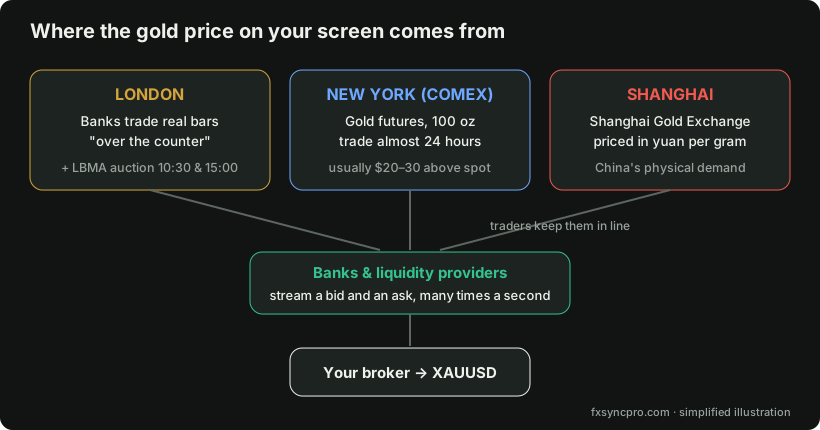
1. London: where the real bars trade
London is the centre of the physical gold world. Huge amounts of gold sit in vaults under the city, including the Bank of England’s, in 400-ounce “Good Delivery” bars (about 12.5 kg each).
Banks trade this gold with each other directly, not on an exchange. This is called over the counter (OTC): two banks agree a price and the gold changes owner inside the vault, usually without moving an inch.
Because it’s private, there’s no single public screen showing every trade. That’s where the auction comes in.
The LBMA Gold Price: the auction twice a day
Twice a day, at 10:30 and 15:00 London time, a group of big banks takes part in an electronic auction run by ICE Benchmark Administration. It works like this:
- A starting price is announced.
- Each bank says how much it wants to buy or sell at that price.
- If buyers and sellers don’t match, the price is nudged up or down and they go again.
- When buying and selling balance, that’s the LBMA Gold Price.
This number is the official “gold price” used in contracts around the world: by central banks, gold miners, jewellers and gold funds. It replaced the old London Gold Fix, which started in 1919 with a handful of men in a room, and was replaced in 2015 amid investigations into price rigging.
You can’t trade the auction from MT5, but it often brings a burst of activity at 10:30 and 15:00 UK.
2. New York: COMEX futures, where most of the trading happens
The second giant is COMEX, part of the CME Group, in the US. It doesn’t trade gold today; it trades gold futures: contracts to buy or sell 100 ounces at a set date in the future.
Futures trade almost 24 hours a day on screens, in huge volumes, and they’re where a lot of the minute-by-minute price discovery happens, especially during US hours and around US news.
Why futures are priced higher than “spot”: a future is gold you get later. The seller has to store it and could have earned interest on the money meanwhile. So futures usually sit above the spot price, right now about $20–30 higher on the December contract. That’s the gap I subtract when I draw gamma levels on my chart, because those come from COMEX options.
3. Shanghai: the world’s biggest buyer sets its own price
China is the world’s biggest buyer of physical gold, and it has its own market: the Shanghai Gold Exchange, priced in yuan per gram, with its own benchmark auction twice a day.
Chinese rules limit how easily gold moves in and out of the country, so Shanghai can trade at a premium or discount to London. A big Shanghai premium is a sign of strong Chinese demand, and traders watch it closely.
So who really sets the price?
All of them, at once.
If gold in New York gets even slightly expensive compared with London, fast traders buy in London and sell in New York until the gap closes. The same happens between London and Shanghai, within the limits of Chinese rules. These arbitrage traders keep the markets glued together, so they move as one, within a few dollars.
In practice:
| Market | What trades there | Its role |
|---|---|---|
| London | Real bars, bank to bank | The physical heart, plus the official benchmark (10:30 and 15:00) |
| COMEX, New York | Futures and options | Most screen trading, and the big moves on US news |
| Shanghai | Physical gold in yuan | China’s demand, and its premium or discount |
Where your XAUUSD price comes from
When you trade gold on MT5, you’re not trading on any of these exchanges directly. You’re trading a CFD: a contract with your broker that tracks spot gold.
- Banks and big trading firms (the “liquidity providers”) watch London, COMEX and the rest, and stream a bid and an ask for spot gold many times a second.
- Your broker takes those prices, adds its spread, and shows them as XAUUSD.
- Your chart usually shows the bid.
That’s why two brokers can show gold a few cents apart, why the spread widens when those banks pull back around big news (more on that in how banks and high-speed firms trade), and why my take-profit once didn’t trigger even though the chart went past it (the spread explained).
What this means for you
- There’s no “true” price to chase. A few cents’ difference between brokers is normal.
- The busiest, most volatile times line up with these markets: the London open (08:00 UK), the auctions (10:30 and 15:00 UK) and US data and the New York open (13:30 to 14:30 UK). The sessions clock shows them in your time.
- Big players leave footprints you can use. The options traded on COMEX are what my gamma levels come from: a free look at where the big money is positioned.
Educational only, not financial advice.