How banks and high-speed firms really trade (and why you shouldn't race them)
By Jason · 8 October 2026
When you press “buy” on your phone, it feels instant. To the fastest firms in the market, your order arrives a very long time later.
Here’s how the big players actually trade, how your order gets to the market, and what that means for a normal trader like me.
Who the “big players” are
Two kinds of firms do most of the trading you’re up against:
- Banks. They make prices for clients (companies, funds, brokers) and execute huge orders for them. Much of this is automated now.
- High-frequency trading (HFT) firms. Trading companies that use their own money and very fast computers to buy and sell thousands of times a second. Some of the biggest names in gold and currency prices are these firms, not banks.
Between them, they’re the market makers: they constantly offer to buy and sell, and they earn the spread in between.
Trick 1: put your computer inside the exchange
Every exchange has a matching engine, the computer that matches buyers and sellers. Gold futures, for example, are matched by CME’s computers in a data centre in Aurora, near Chicago.
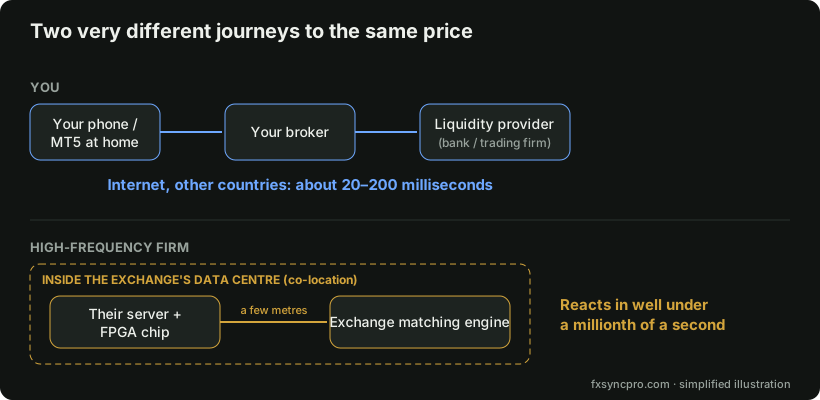
The fastest firms pay to put their own servers in the same building, a few metres away. This is called co-location. Their orders travel down a short cable instead of across the internet.
It’s so competitive that exchanges give every co-located firm the same length of cable, so nobody gets an edge just by having a closer rack.
Trick 2: send prices through the air, not cables
Prices from one market matter to another. A move in New York matters to Chicago, and the other way round.
Light in a fibre-optic cable is about a third slower than through air, and cables have to follow roads and railways. So firms built chains of microwave towers in as straight a line as possible between the big financial centres.
- Chicago to New Jersey by fibre: about 6.5 milliseconds.
- The same trip by microwave: about 4 milliseconds.
That 2.5-millisecond head start is worth millions a year to them. There are similar tower routes between London and the European exchanges.
Trick 3: chips built for one job
A normal computer runs an operating system and lots of software, and that takes time. The fastest firms put their trading logic directly onto special chips called FPGAs, which are wired to do one job only.
The time from “a new price arrives” to “our order goes out” is now well under a microsecond (a millionth of a second). The quickest systems are measured in tens of nanoseconds (billionths of a second).
For comparison, a blink takes about 300 milliseconds. In one blink, a fast firm could react millions of times.
How your order actually gets filled
When I trade gold on my phone, my order goes:
- from my phone or MT5 to my broker’s servers, over the internet,
- then either the broker takes the other side itself, or it passes the trade to a liquidity provider (a bank or a trading firm),
- which is already plugged into the real market at high speed.
That trip takes tens to hundreds of milliseconds. By the time my order lands, the fast firms have seen the move, re-priced and moved on.
What this means for you and me
1. Don’t try to race them. Scalping a few cents on a 1-minute chart puts you in direct competition with machines that are thousands of times faster. That’s a fight you lose on speed alone. It’s one reason I trade from the 1-hour chart: a move of $10–20 doesn’t depend on milliseconds.
2. Spreads widen when the machines step back. Around big news (NFP, CPI) and at the daily close, market makers pull their prices to protect themselves. Fewer prices means wider spreads and more slippage. That’s why I don’t trade 15 minutes either side of high-impact news. I explain the spread in why my take-profit didn’t trigger.
3. Their hedging leaves footprints you can use. Banks that sell options have to hedge by buying and selling the market as price moves. They don’t do it by hand, but it’s predictable enough to map. That’s exactly what gamma levels are: the places where the big players’ hedging is likely to slow price down or speed it up. You don’t need their speed to use their map.
4. Your edge is patience, not speed. The machines are brilliant at tiny, fast profits. They’re not trying to sit in a trade for hours from a level they marked up the night before. A slower, planned trade isn’t competing with them at all.
The honest bit
Most of this world is secret: firms don’t publish exactly how fast they are or how they trade, and the numbers above are the widely reported ballpark, not exact figures. The big picture is well known, though: speed belongs to the machines, so trade where speed doesn’t matter.
Educational only, not financial advice.