How traders scalp futures using only the DOM (order book), explained
By Jason · 10 October 2026
Some traders never look at a candlestick chart. They stare at a column of numbers, the DOM, and click in and out of trades in seconds or minutes, aiming for a few ticks at a time.
Here’s what the DOM actually is, what these traders are looking for, and how they do it, with examples on micro gold futures (MGC).
What the DOM is
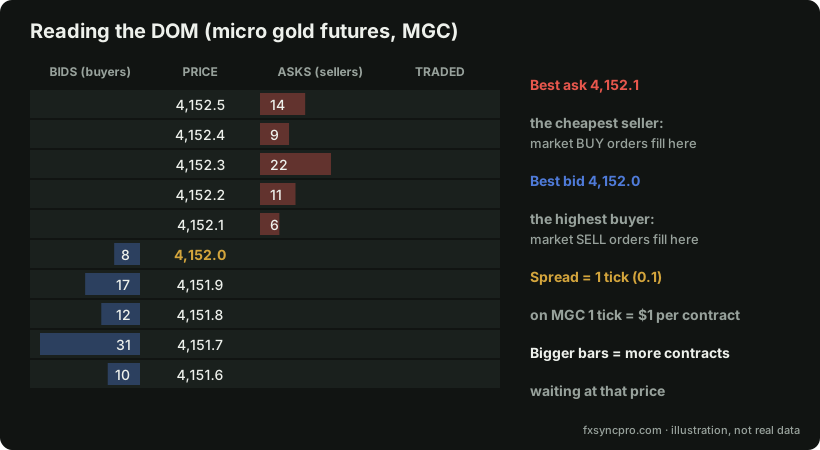
DOM stands for Depth of Market. It’s also called the order book or the ladder. It shows every price level near the current price, and how many contracts are waiting to buy or sell at each one.
| Part | What it shows |
|---|---|
| Bids (left, blue) | Buy orders waiting at each price: buyers who want price to come to them |
| Asks (right, red) | Sell orders waiting at each price |
| Best bid / best ask | The highest buyer and the cheapest seller. The gap between them is the spread |
| Traded (or “volume at price”) | How many contracts actually traded at each price |
Two kinds of order move price:
- Limit orders sit and wait on the ladder. They’re the numbers you see. They add liquidity.
- Market orders hit the ladder right now. A market buy takes contracts from the asks, a market sell takes from the bids. They remove liquidity, and when they eat through every contract at a price, price moves one tick.
That’s the whole game: price only moves when the market orders use up what’s waiting. DOM scalpers watch that fight live.
Why it only really works on futures
On an exchange like CME, every trader’s orders sit in the same book. The DOM you see is the real market.
With a CFD broker (like my Vantage gold account), there’s no shared book. You trade against your broker’s prices, so a “DOM” there only shows that broker’s quotes. DOM scalping is a futures thing. For gold that means:
| Contract | Size | 1 tick | Value of 1 tick |
|---|---|---|---|
| MGC (micro gold) | 10 oz | $0.10 | $1 |
| GC (full gold) | 100 oz | $0.10 | $10 |
Micro gold is where most people should learn: a 5-tick stop is only $5 per contract.
The other half: the tape
The DOM shows what’s waiting. The time and sales window (the tape) shows what actually traded: every trade, its price, its size, and whether it hit the bid (a seller) or lifted the ask (a buyer).
DOM scalpers read both together. Orders on the ladder can be cancelled in an instant. Trades on the tape can’t. The tape is the truth; the DOM is the intention.
The 4 patterns DOM scalpers trade
1. Absorption: a big player soaking up the selling
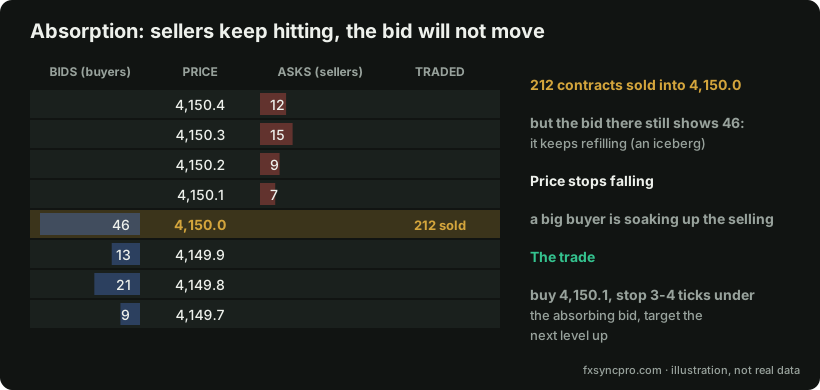
Sellers keep hitting the bid at 4,150.0. The tape shows hundreds of contracts traded there, but the bid doesn’t get used up. It keeps refilling. That’s usually an iceberg order: a big buyer showing only a small part of their order at a time.
The trade: when the selling dries up and price ticks back up, buy just above the absorbing bid, stop a few ticks under it, target the next level. If that bid finally breaks, get out: the big buyer is done.
2. Pulling and stacking: the path gets cleared
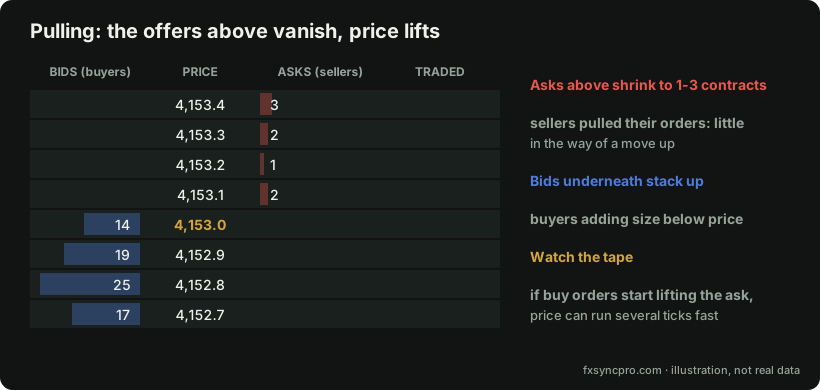
The asks above price shrink: sellers are cancelling (pulling) their orders. At the same time, bids stack up underneath. There’s little in the way of a move up and plenty of support below.
The trade: wait for the tape to confirm. When buyers start lifting the ask, join them for a few ticks.
Be careful: size on the ladder can be fake. Some orders are placed to be seen and cancelled before they ever trade. Never trade a big number on the DOM on its own; wait until the tape shows real trades.
3. The sweep: momentum you ride for a few ticks
A big market order (or a burst of them) eats through several price levels at once. You see it as a large print on the tape and price jumping 3 to 5 ticks in a moment. After a sweep, price often keeps going a little as others chase it.
The trade: go with the sweep, take a few ticks, get out fast. This is the hardest one, because high-speed firms are faster than any human (how they trade).
4. Fading at a level: the DOM at your chart levels
The way I’d use it, and the way many traders do: mark the levels on your chart first (session highs and lows, gamma levels), then use the DOM only when price gets there.
At the level, you watch for absorption (pattern 1). If the selling is absorbed at a support level, it’s a much better buy than one from the chart alone. If the bids get swept away instead, the level is breaking and you stay out.
The tools DOM scalpers use
| Need | Examples |
|---|---|
| A real-time DOM with one-click trading | Sierra Chart, Jigsaw, NinjaTrader, ATAS, Rithmic R Trader |
| A “heatmap” of the order book over time | Bookmap, ATAS |
| Market depth data | Paid CME depth data through your platform or prop firm |
| Practice | Market replay of recorded depth data, or a simulator account |
One-click trading with brackets is essential: you click a price on the ladder and the order goes in at once, with a stop and target already attached. Typing a stop after you’re in is far too slow for scalping.
Costs: the silent killer
Scalpers trade a lot for a few ticks each, so costs matter more than for any other style.
On micro gold, a round trip (in and out) typically costs around $1–2 per contract in commission and exchange fees, depending on your broker or prop firm. That’s 1–2 ticks you have to make back on every trade before you earn anything. A scalper aiming for 4 ticks is giving away a large slice of every win.
Rules most DOM scalpers live by
- Trade only the busiest hours. For gold: the London open and the New York session (13:30 to 17:00 UK). Thin books are easy to push around.
- Stay out of the first seconds of big news. The book empties, and stops slip badly.
- Tiny, fixed stops in ticks, set before you click in.
- A daily loss limit, then stop. Fast trading means fast tilt.
- Practise on replay first. Reading the DOM is a skill built over hundreds of hours, not a setting.
The honest bit
DOM scalping is a real skill and some traders make a living from it. It’s also one of the hardest ways to trade: you’re closest to the fastest machines in the market, costs eat your edge, and it needs full attention every second.
If you want to try it, start with one micro contract, at your own chart levels, in replay or simulation, and treat the DOM as a way to time an entry at a level, not as a signal on its own.
Educational only, not financial advice.